NOAC hosted its eighth Good Practice in Local Government Seminar, in collaboration with the Local Government Management Agency and the County and City Management Association, in the historic surrounds of Kilkenny Castle on 10th March 2026.
This key event in the local government calendar allowed for the showcasing of a wide range of local authority initiatives such as the Development and Implementation of Equity Register Module for Affordable Housing Scheme, the launch of 'Lámhleabhar Gaeilge', Online Purchase Request Form for libraries, 60+ Climate Action Drive, HR Onboarding App and Robitic Process Automation of the MyPay Superannuation Starter Notification Process
The projects on show demonstrated examples of good practice in local government that can be replicated across much of the sector, encouraging the sharing of knowledge within the sector and allowing local authorities to improve the lives of the communities that they serve.

Case Study Presentations
View individual presentations from the seminar below:
Fingal County Council
Fingal County Council developed and implemented an Equity Register Module on Agresso to assist in the management of its role as a secondary lender under the Affordable Housing Scheme, where the Council retains a long term equity share in affordable homes. Managing equity shares investment involves meticulous tracking of complex financial and legal information, including purchaser details, equity percentages, redemption payments, and associated legal documents.
To address risks around accuracy, security, and long term management, Fingal County Council collaborated with Ascendas Business Solutions who were engaged to develop a Loans Module for Agresso. The module automates complex equity calculations, enhances reporting, and ensures transparency in managing public funds.
The equity Register is now fully operational in Fingal County Council and has delivered significant benefits -
Registered 1,046 affordable properties;
Recorded €69 million in equity shares issued to purchasers;
Streamlined reporting and departmental grant drawdowns; provides robust data for forecasting and financial planning; the project demonstrates best practice through its strong interdepartmental coordination, partnership with an Irish software provider, and its scalability for use by other local authorities. It addresses the core challenge of safeguarding significant financial and legal information related to long-term equity shares under the Affordable Housing Scheme, ensuring transparent, accountable management of public funds.
Offaly County Council
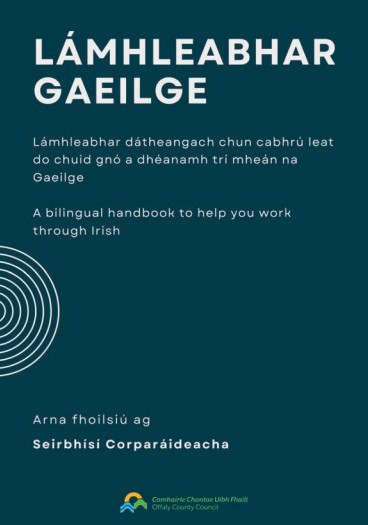
The publication of Lámhleabhar Gaeilge represents a practical and innovative step towards promoting the Irish language within Offaly County Council. This initiative demonstrates how local authorities can lead by example in conserving and promoting our national language. By focusing on accessibility, usability, and statutory compliance, the handbook empowers staff and Councillors to engage with Irish in a meaningful way, ensuring it remains a living part of our daily interactions.
This initiative demonstrates how Offaly County Council is embedding Irish language use into its internal culture, rather than treating compliance as a mere formality. It reflects a genuine commitment to making Irish visible and accessible in the workplace, in line with national policy objectives for language preservation and revitalisation as we move towards 2030.
The handbook was circulated internally to all Councillors in 2025, accompanied by a short briefing session to explain its purpose and demonstrate its use. Feedback has been overwhelmingly positive. Staff have reported feeling more comfortable incorporating Irish into emails and meetings, while Councillors have expressed appreciation for a resource that supports them in fulfilling their public role with confidence.
Cork County Council
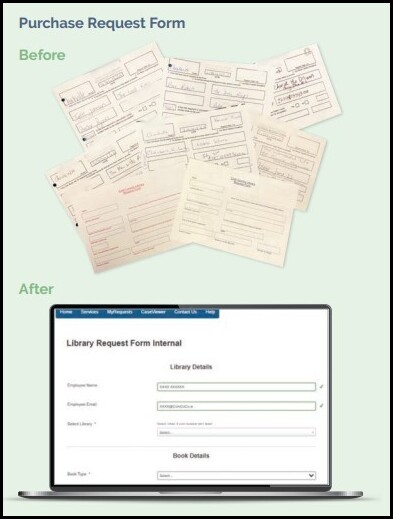
The library purchasing team identified the need to improve the internal paper-based system by moving to an online digital system.
Staff in the purchasing team work with Cork County Council’s Service Design and Transformation Team (SDT) to develop an online request form on the staff portal. The process involved initial consultation between librarians and the SDT team followed by building, reviewing and revising the form.
It was then piloted in two branch libraries, rolled out across all branches and finally evaluated through a staff feedback survey.
The introduction of the forms has resulted in:
Streamlined and centralised purchase requests, improving tracking, transparency, and team collaboration;
Continuity of purchase requests being received regardless of staff absences or delivery delays with internal post;
Increased efficiency because of standardised data inputs;
The online form should reduce paper usage in alignment with long-term sustainability goals;
Provision of accurate monthly statistics on purchase requests for informed planning and reporting.
Galway County Council
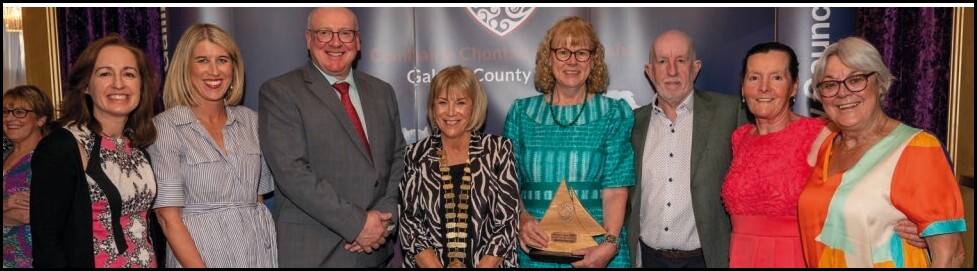
The 60+ Climate Drive was delivered as a grassroots, community-based initiative led voluntarily by retired UN Resident Coordinator Jacinta Barrins. She designed and facilitated a six-week climate action course for older adults, travelling across Galway City and County to meet groups in their own communities. The conversational, accessible format of this drive ensured participants felt confident exploring climate science and behaviour change.
The project exemplifies good practice by demonstrating how local authorities can collaborate effectively with skilled external experts. Through partnership with Galway County Council’s Climate Action Unit, Jacinta aligned her outreach with local priorities while engaging Men’s Sheds, Women’s Groups, carers’ networks and Active in Age groups—showcasing a scalable, low cost engagement model that other councils can replicate.
The initiative responds to a clear need to engage older adults - a demographic often overlooked in climate policy. By addressing gaps in climate literacy and motivation, the project empowers over-60s to take meaningful, practical climate action.
Kildare County Council
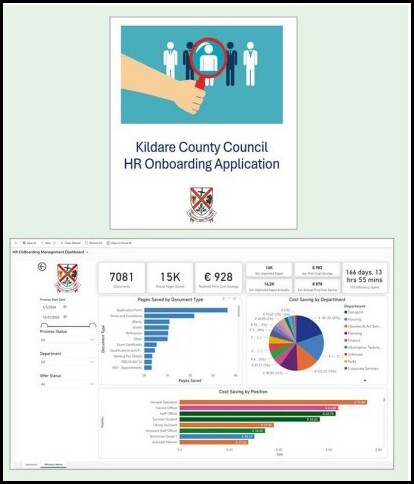
Kildare County Council’s Onboarding App was delivered through a fully collaborative, in-house partnership between the HR Recruitment Team and the IT Development Section. Using existing Microsoft Power Platform licences, the project was designed through joint workshops, iterative testing, and inclusive decision making, ensuring the system reflected real operational needs while incurring zero additional cost.
The project exemplifies best practice by demonstrating how local authorities can leverage existing technologies to solve shared challenges such as high recruitment volumes, remote accessibility, data security, and paper heavy processes. Its success highlights opportunities for wider sectoral collaboration, the same pattern (Dataverse, Power Apps, Power Automate, MS Graph API and iDocs) can be used and adapted for other services, supporting council wide digital consistency.
The app addresses the significant increase in recruitment activity since 2020 and the inefficiencies of a manual, paper-based onboarding process. It creates a streamlined, paperless, auditable workflow that improves efficiency, reduces risk, supports blended working, and provides real-time recruitment data for enhanced decision making.
Laois Council Council
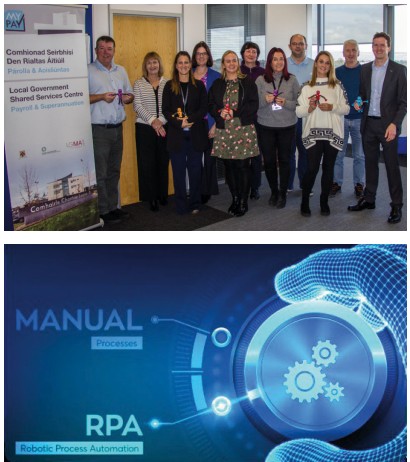
The MyPay RPA Starters project introduced Robotic Process Automation (RPA) to automate the Superannuation Starter Notification process within Local Government’s flagship payroll and superannuation shared service (MyPay). The process had been manual, repetitive, and resource-intensive, with increasing volumes and compliance demands placing pressure on staff capacity and turnaround times.
Delivered under the Office of Government Procurement RPA Framework and primarily funded by the DHLGH’s Local Government Digital Transformation Fund with great support from the LGMA’s PMO office, the project deployed an unattended software bot (“Mandy”) to validate, process, and update starter notifications across systems with minimal human intervention.
The solution has processed over 2,700 starter notification forms since the project launch in April 2025, delivering efficiency savings comparable to approximately three full-time equivalents, improving data accuracy, strengthening audit controls, and enabling staff redeployment to higher-value work. The approach is scalable, transferable to other shared service processes, and demonstrates practical, people-centred digital transformation within Local Government.